
Wyandotte County Court Records After Jail Arrest
Wyandotte County criminal cases are handled in Kansas's 29th Judicial District. After a person is booked into the Wyandotte County Detention Center, the jail record is only one part of the trail. The formal court record starts when a charging document is filed and a case is opened in district court. District Attorney Mark A. Dupree, Sr. and his office review police reports, jail booking facts, witness information, and legal proof before deciding what charges to file. That decision may match the arrest charge, but it also may narrow, add, amend, or decline counts.
The booking side and the court side should be read together. The jail roster can help identify a booking number, arresting agency, bond row, charge description, or court row, while Kansas CaseSearch and courthouse terminals show the district-court record after filing. For the custody and roster side of a booking, use Wyandotte County jail inmate records. For booking photos and roster image behavior, use the Wyandotte County jail mugshots page. The court record is the better source for filed charges, hearings, disposition, sentence, costs, and later case activity.
The 29th Judicial District Court says its records are available through Kansas CaseSearch, and public terminals are available at the Wyandotte County courthouse. The court's local home page at wycodistrictcourt.org is the county-specific entry point for court access, while the Unified Government's District Attorney page identifies Mark A. Dupree, Sr. as the elected prosecutor. Sheriff Daniel Soptic's office operates the county jail records that often supply the first clue for a later court lookup.
Find Wyandotte Court Records After Arrest
Start with the arrest and booking details, then move to the court index. The Wyandotte County Sheriff's inmate-search page routes users to the public jail roster for people booked into the jail. If the person is still in custody, note the spelling of the name, booking number, case number if shown, OTN, charge description, bond status, and hearing row. Then search the state court portal. CaseSearch states that Kansas district court records may be searched by case number, party name, business name, citation, or other criteria available to the user's role.
- Open Kansas CaseSearch and choose a search path that fits the information available from the jail record or court paperwork.
- Search by defendant name first when no case number is known. Use full legal names when possible.
- Search by case number when it appears in the roster charge or court tab, bond paper, citation, or notice.
- Open the case record and compare each filed charge with the booking charge shown by the jail.
- Check hearing dates, bond orders, disposition, and sentence fields before treating the case as resolved.
The state court portal is not the only access point. The Kansas Judicial Branch district-court records page describes statewide CaseSearch and courthouse terminal access. If an online search does not show a record, the case may be sealed, too old for the online index, juvenile, not yet filed, filed under a variant name, or available only at a terminal or from the clerk. The Wyandotte County court cases page lists the main courthouse at 710 North 7th Street in Kansas City, Kansas, and provides court contact information for local case questions.
The Kansas Criminal History Record Search is a different system. It is used for broader Kansas criminal-history searches and requires a KanAccess account. A CaseSearch entry is best for a specific district-court case after a Wyandotte County arrest. A criminal-history search is broader, may have different access rules, and should not be treated as the same thing as a live court docket.
Wyandotte Court Search Fields
Kansas CaseSearch was not fully accessible for live form capture during research, but official Kansas court search descriptions identify the public fields used for district-court lookup. These fields matter because a jail booking may not contain every court detail on the first day. If the arrest happened very recently, search by name first, then repeat the search after the prosecutor has had time to file. A copied case number is stronger than a name search when the jail record or court notice includes it.
| Field Label | Type | Required | Options / Format Notes |
|---|---|---|---|
| Case number | Text | Optional depending on search | Best when copied from the roster charge tab, court tab, citation, bond paper, or notice. |
| Party name | Text | Optional | Use the defendant's legal name and check common spelling variants. |
| Business name | Text | Optional | Used when an organization is a party rather than a person. |
| Citation | Text | Optional | Useful for traffic or municipal-style citations when district-court data includes them. |
| Other criteria | Role-specific | Unspecified | The portal states that available criteria can vary by the user's role. |
The 29th Judicial District Court home page is the local court's own access point for Wyandotte County court records after arrest.
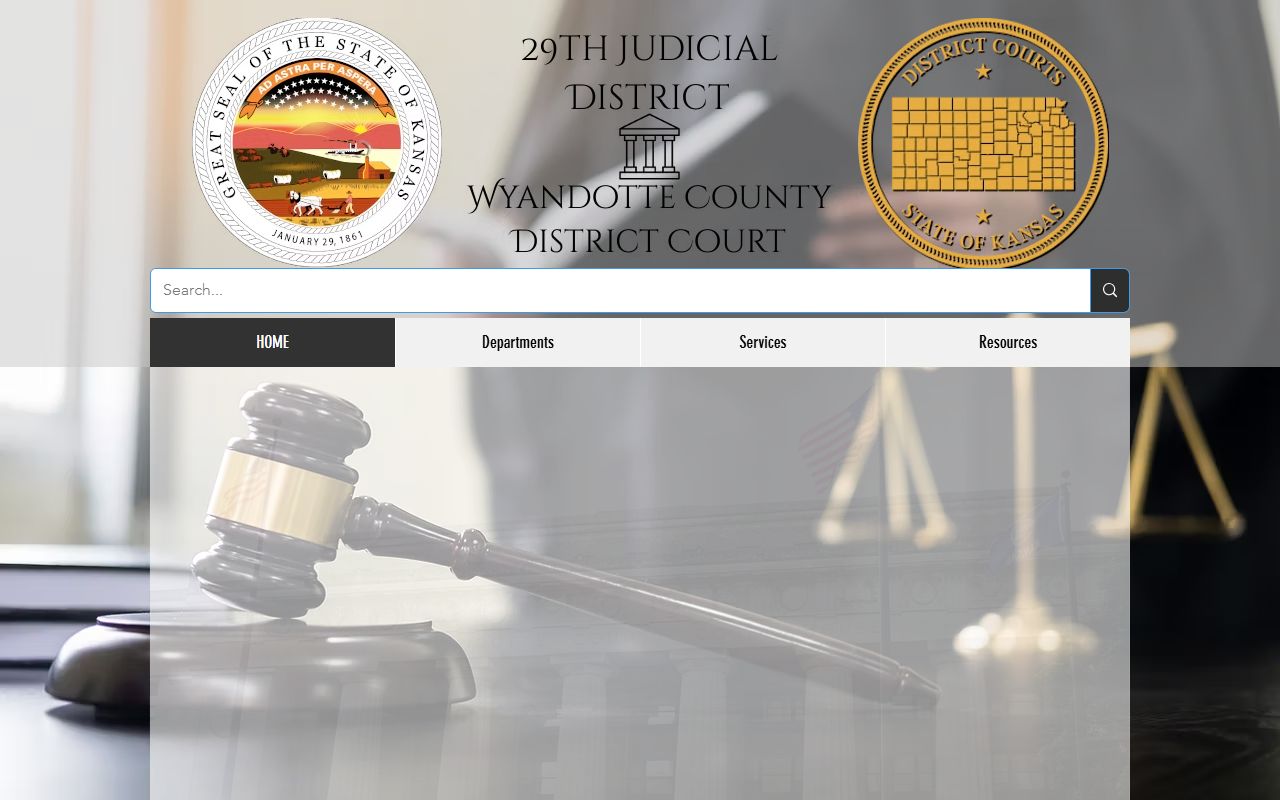
The local court page points users toward CaseSearch and courthouse terminals, which is important when an online result does not include every document image or older entry.
Charging Documents After Arrest
A Wyandotte County arrest can begin with police or sheriff allegations, but the court case begins with a charging document. The document is the legal paper that tells the court and the defendant what charge is being pursued. A complaint can start many cases. An information is a formal charge filed by the prosecutor, often after review or a preliminary stage. An indictment is a grand-jury charge and is less common in routine local filings. Each document can be amended later if the proof or legal theory changes.
| Document | Filed By | Common Use | What It Means for the Record |
|---|---|---|---|
| Complaint | Prosecutor, often based on law-enforcement reports | Initial criminal filing after arrest | Starts the court case and lists the charge or charges being alleged. |
| Information | Prosecutor | Formal felony or misdemeanor prosecution | Sets out the filed charge after prosecutor review and may replace or refine earlier allegations. |
| Indictment | Grand jury | Serious or specially reviewed cases | Creates a formal charge based on grand-jury action rather than a standard complaint path. |
The table does not mean every Wyandotte County court record has all three documents. It shows why a jail charge and a filed court charge can differ. A person may be booked on one description, charged under a more precise statute, or released if no charge is filed. That is why court records after a jail arrest should be checked after the filing decision, not just during the first booking window.
Wyandotte Charge Status Records
Charge status is the part of the court record that shows where a count stands. A filed charge is an accusation, not a finding of guilt. The status may stay pending through hearings, change after plea talks, or end by dismissal. A charge can also be amended or reduced when the prosecutor files a revised count. CaseSearch and courthouse records should be used to check the latest status, because a jail roster field may still show the booking allegation or an older bond row.
| Status | What It Means | Why It Matters |
|---|---|---|
| Pending | The charge has been filed and has not reached final disposition. | Future hearings, bond terms, or plea settings may still be active. |
| Amended | The filed charge was changed by later court action. | The new wording, level, or statute may be more important than the booking charge. |
| Reduced | The charge level or charge type was lowered. | Sentencing exposure, collateral effects, and public interpretation can change. |
| Dismissed | The charge was ended without conviction on that count. | A dismissed count should not be described as a conviction. |
| Disposition entered | The court has recorded an outcome such as plea, finding, dismissal, or sentence. | The disposition is the key field for final case status. |
The Kansas CaseSearch portal is the statewide public search point for district-court records, including Wyandotte County case lookups.
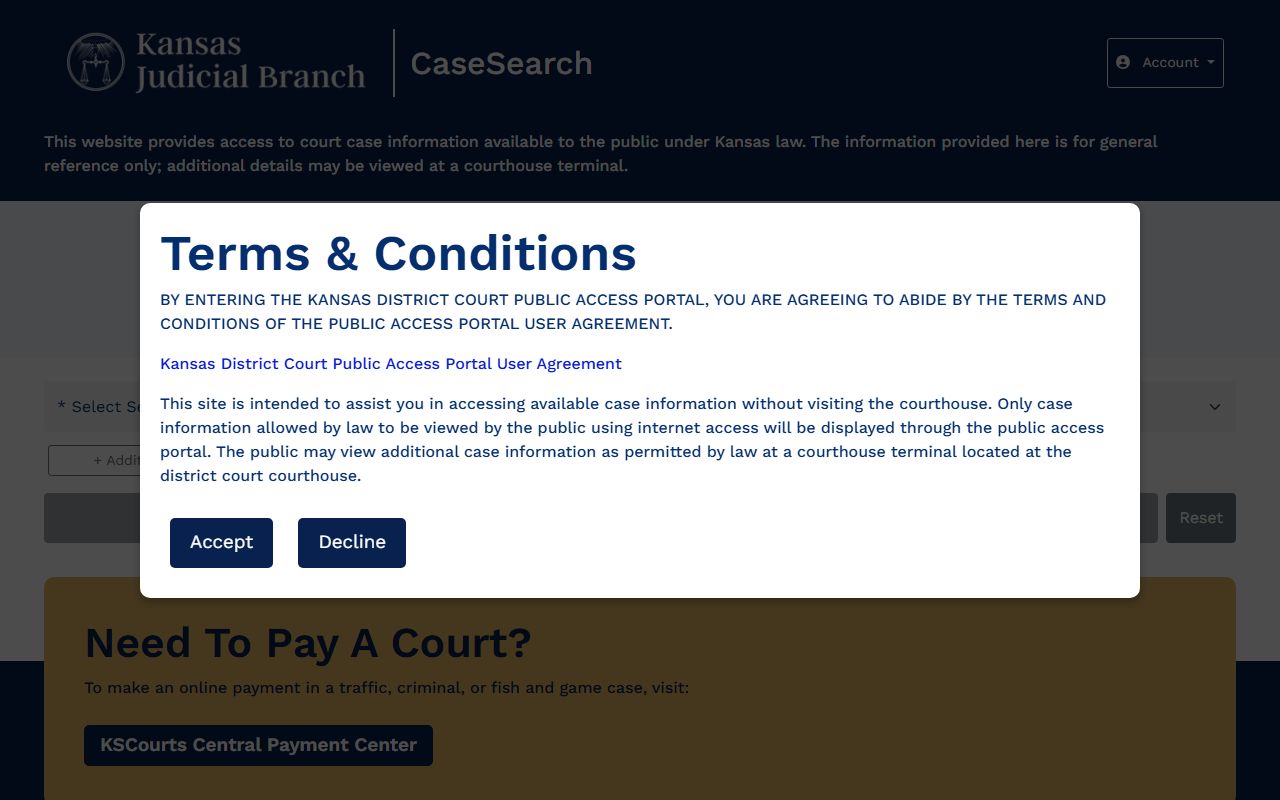
CaseSearch is separate from the jail roster, so a person can appear in one system before a complete record appears in the other.
Bond After Wyandotte Arrest
Bond records connect the jail record and the court record. The BlueHorse roster can expose bond data when the facility's public-field settings allow it. The recorded fields include agency, bond type, bond amount, and bond status. Charge rows may also include a bond field, while detainers or holds may list a separate agency, bond amount, or bond method. A bond amount alone does not guarantee release. Another warrant, parole hold, immigration detainer, out-of-county hold, or court no-bond order can keep a person in custody.
| Bond Type | How It Works | What to Verify |
|---|---|---|
| Cash | The full cash amount is posted as required by the court or jail order. | Confirm the pay location and whether any hold blocks release. |
| Surety | A licensed bail agent posts a bond guarantee. | Check whether the court permits surety for that case. |
| Personal recognizance | The person is released on a promise to appear, often with conditions. | Read all conditions and future court dates. |
| No bond | The order or warrant does not allow release by payment at that stage. | Contact the issuing court or counsel for the next hearing path. |
| Hold or detainer | A separate agency or court order prevents release. | Identify the agency and case that created the hold. |
The Sheriff's Inmate Services page covers incarceration and bond status resources, but exact accepted payment methods were not captured in accessible text. Call the Wyandotte County Detention Center or the relevant court before paying. This is especially important when a municipal case, district-court case, or out-of-county warrant is involved.
Warrants Before Court Records
No dedicated official Wyandotte County Sheriff active-warrant search was located in accessible official sources during research. That gap changes the lookup path. If a warrant has already led to arrest, the person may show on the jail roster with charges, holds, detainers, bond, and court data. If the warrant is tied to a filed district-court case, Kansas CaseSearch may show bench-warrant activity, failure-to-appear events, bond status, and future hearings. Municipal warrants may sit in a separate municipal-court path.
Warrant types can include arrest warrants, bench warrants, fugitive or out-of-county warrants, probation or parole violation warrants, and municipal failure-to-appear warrants. Search results should not be used as legal advice. If an active warrant is suspected, the issuing court or a defense attorney can explain surrender, bond, and hearing options. For records requests, KORA may allow access to some warrant-related records, but criminal-investigation, sealed, juvenile, and privacy-based exemptions can limit release.
Charges vs Convictions
Wyandotte County court records after a jail arrest must be read with one key distinction in mind. A charge is an allegation that has been filed. A conviction is an outcome that follows a plea, verdict, or qualifying court finding. A person can be arrested, booked, charged, and later have the charge dismissed. A person can also have some counts dismissed and another count resolved by plea. Public records may contain each step, but they do not all carry the same meaning.
| Point of Comparison | Charge | Conviction |
|---|---|---|
| Stage | Accusation filed in court after arrest review. | Final finding or plea entered by the court. |
| Proof level | Based on probable cause or filing standards. | Requires proof beyond a reasonable doubt or an accepted plea. |
| Record language | May appear as pending, amended, dismissed, or reduced. | Appears with disposition and sentence information when complete. |
| How to cite it | Describe it as a charge unless the record shows final guilt. | Describe it as a conviction only when the disposition supports that wording. |
Sealed vs Expunged Records
Kansas access rules can limit what appears online after a Wyandotte County arrest. Some juvenile matters, sealed cases, expunged records, and exempt criminal-investigation records may be missing from public search results or partly redacted. KORA does not make every law-enforcement or court document public on demand. K.S.A. 45-221 lists categories that agencies are not required to disclose, and it also requires open and closed material to be separated where possible.
| Point of Comparison | Sealed | Expunged |
|---|---|---|
| Public visibility | Hidden from ordinary public access by court rule or order. | Treated through a statutory record-clearing process when eligibility is met. |
| Who may still see it | Access may remain for courts, law enforcement, or parties allowed by law. | Access can still exist for limited official purposes depending on Kansas law. |
| Effect on searches | Online search may show no result or less detail. | Public-facing records may be removed, withheld, or marked under the expungement order. |
| How it happens | By legal restriction, case type, or court order. | By petition or statutory process after an eligible outcome. |
For public-record requests outside the court portal, the Unified Government's Request a Record page explains the local KORA process. K.S.A. 45-218 governs inspection, response, refusal, and fees. K.S.A. 45-220 requires agencies to adopt records-request procedures and identify custodians. A request should identify the person, date, arresting agency, case number if known, and the exact record sought.
Restricted Wyandotte Court Records
Not every court record after an arrest is public in the same way. Juvenile cases, sealed proceedings, expunged records, protected addresses, medical details, victim information, and some criminal-investigation material can be withheld or redacted. Body-camera and vehicle-camera recordings have special rules under K.S.A. 45-254. Kansas sheriff and jail-duty statutes also define custody authority, but those laws do not turn every custody file into a public court record.
Important: A filed charge is not a conviction, and a missing online case is not proof that no court record exists.